
Lennard-Jones 38 clusters with Gaussian force noise
SystemLennard-Jones
Atoms38
Runs1000
Cap10000 force calls
The main metric is Force calls. Scoring rules.
Charts
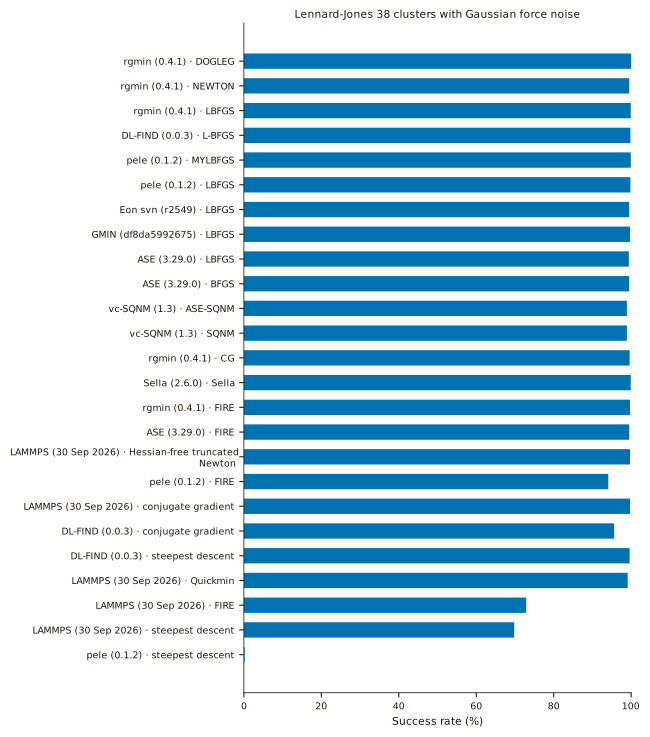
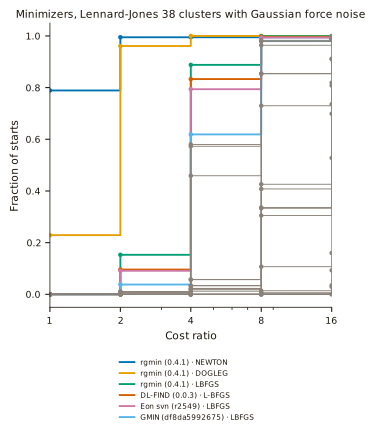
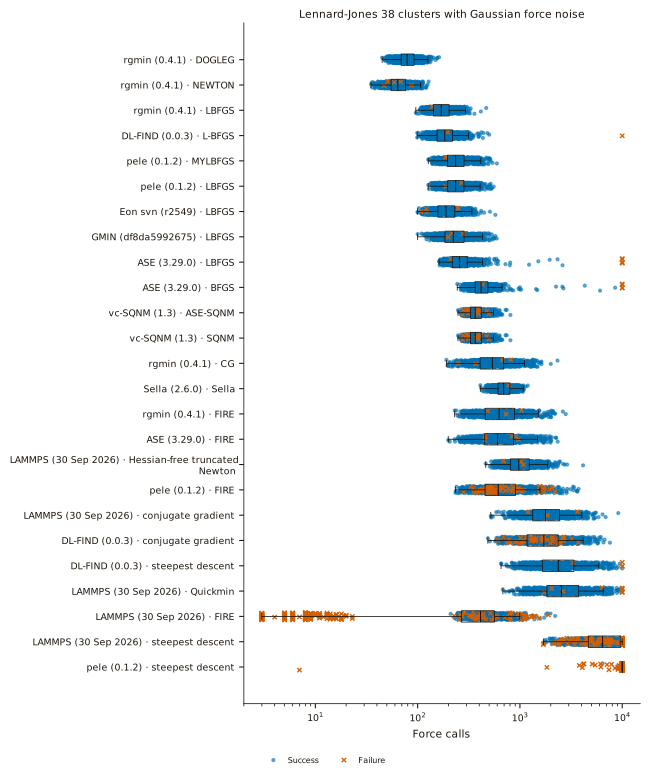
- rgmin (0.4.1) · NEWTON
- rgmin (0.4.1) · DOGLEG
- rgmin (0.4.1) · LBFGS
- DL-FIND (0.0.3) · L-BFGS
- Eon svn (r2549) · LBFGS
- GMIN (df8da5992675) · LBFGS
Performance profile SVG Cost and success SVG
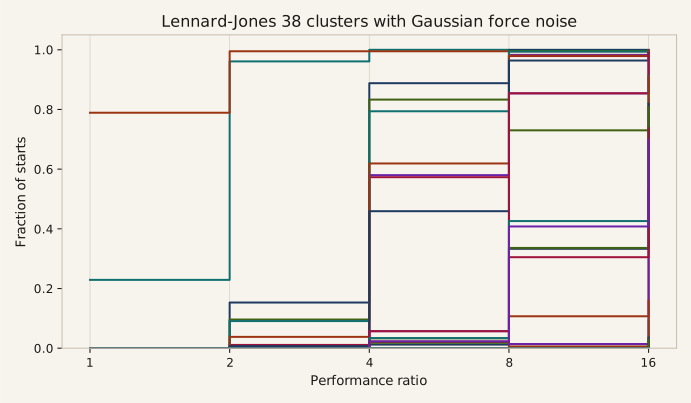
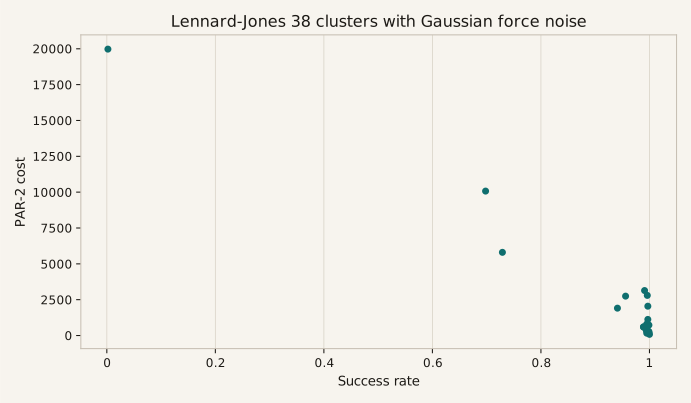
Leaderboard
| Rank | Code | Best | Median | Success | PAR-2 |
|---|---|---|---|---|---|
| 1 | rgmin | 197.228 | 100.0% | 81.881 | |
| 2 | DL-FIND | 2747.86 | 99.8% | 231.908 | |
| 3 | pele | 1098.85 | 99.9% | 268.036 | |
| 4 | Eon svn | 300.052 | 99.5% | 300.052 | |
| 5 | GMIN | 301.399 | 99.7% | 301.399 | |
| 6 | ASE | 555.614 | 99.4% | 396.55 | |
| 7 | vc-SQNM | 598.05 | 98.9% | 598.05 | |
| 8 | Sella | 729.433 | 99.9% | 729.433 | |
| 9 | LAMMPS | 3138.21 | 99.7% | 1123.81 |
The tables below list every ranked row, by method family and overall.
A run short of the full set, or a run that is not the stock method, stays off the ranked table.
Minimizers
| Rank | Row | Cost | Unit | Hessians | FD calls | Runs |
|---|---|---|---|---|---|---|
| 1 | rgmin (0.4.1) · DOGLEG | 81.881 | force calls | 80.881 | 9220.43 | 1000 |
| 2 | rgmin (0.4.1) · NEWTON | 166.337 | force calls | 65.649 | 7483.99 | 1000 |
| 3 | rgmin (0.4.1) · LBFGS | 197.228 | force calls | 0 | 0 | 1000 |
| 4 | DL-FIND (0.0.3) · L-BFGS | 231.908 | force calls | 0 | 0 | 1000 |
| 5 | pele (0.1.2) · MYLBFGS | 268.036 | force calls | 0 | 0 | 1000 |
| 6 | pele (0.1.2) · LBFGS | 288.145 | force calls | 0 | 0 | 1000 |
| 7 | Eon svn (r2549) · LBFGS | 300.052 | force calls | 0 | 0 | 1000 |
| 8 | GMIN (df8da5992675) · LBFGS | 301.399 | force calls | 0 | 0 | 1000 |
| 9 | ASE (3.29.0) · LBFGS | 396.55 | force calls | 0 | 0 | 1000 |
| 10 | ASE (3.29.0) · BFGS | 555.614 | force calls | 0 | 0 | 1000 |
| 11 | vc-SQNM (1.3) · ASE-SQNM | 598.05 | force calls | 0 | 0 | 1000 |
| 12 | vc-SQNM (1.3) · SQNM | 598.05 | force calls | 0 | 0 | 1000 |
| 13 | rgmin (0.4.1) · CG | 669.237 | force calls | 0 | 0 | 1000 |
| 14 | Sella (2.6.0) · Sella | 729.433 | force calls | 0 | 0 | 1000 |
| 15 | rgmin (0.4.1) · FIRE | 769.36 | force calls | 0 | 0 | 1000 |
| 16 | ASE (3.29.0) · FIRE | 802.384 | force calls | 0 | 0 | 1000 |
| 17 | LAMMPS (30 Sep 2026) · Hessian-free truncated Newton | 1123.81 | force calls | 0 | 0 | 1000 |
| 18 | pele (0.1.2) · FIRE | 1909.56 | force calls | 0 | 0 | 1000 |
| 19 | LAMMPS (30 Sep 2026) · conjugate gradient | 2046.69 | force calls | 0 | 0 | 1000 |
| 20 | DL-FIND (0.0.3) · conjugate gradient | 2747.86 | force calls | 0 | 0 | 1000 |
| 21 | DL-FIND (0.0.3) · steepest descent | 2798.89 | force calls | 0 | 0 | 1000 |
| 22 | LAMMPS (30 Sep 2026) · Quickmin | 3138.21 | force calls | 0 | 0 | 1000 |
| 23 | LAMMPS (30 Sep 2026) · FIRE | 5802.74 | force calls | 0 | 0 | 1000 |
| 24 | LAMMPS (30 Sep 2026) · steepest descent | 10074.7 | force calls | 0 | 0 | 1000 |
| 25 | pele (0.1.2) · steepest descent | 19975.4 | force calls | 0 | 0 | 1000 |
Overall
| Row | Family | Family rank | Unit | PAR-2 | Published | Median calls | Mean calls | Hessians | FD calls | Failures | Runs |
|---|---|---|---|---|---|---|---|---|---|---|---|
| rgmin (0.4.1) · DOGLEG | Minimizers | 1 | force calls | 81.881 | 79 | 81.881 | 80.881 | 9220.43 | crash 0, divergence 0, cap 0, wrong_stationary 0 | 1000 | |
| rgmin (0.4.1) · NEWTON | Minimizers | 2 | force calls | 166.337 | 64 | 66.649 | 65.649 | 7483.99 | crash 0, divergence 0, cap 0, wrong_stationary 5 | 1000 | |
| rgmin (0.4.1) · LBFGS | Minimizers | 3 | force calls | 197.228 | 170 | 177.367 | 0 | 0 | crash 0, divergence 0, cap 0, wrong_stationary 1 | 1000 | |
| DL-FIND (0.0.3) · L-BFGS | Minimizers | 4 | force calls | 231.908 | 184 | 202.105 | 0 | 0 | crash 0, divergence 0, cap 1, wrong_stationary 1 | 1000 | |
| pele (0.1.2) · MYLBFGS | Minimizers | 5 | force calls | 268.036 | 235 | 248.224 | 0 | 0 | crash 0, divergence 0, cap 0, wrong_stationary 1 | 1000 | |
| pele (0.1.2) · LBFGS | Minimizers | 6 | force calls | 288.145 | 235 | 248.601 | 0 | 0 | crash 0, divergence 0, cap 0, wrong_stationary 2 | 1000 | |
| Eon svn (r2549) · LBFGS | Minimizers | 7 | force calls | 300.052 | 189 | 200.9 | 0 | 0 | crash 0, divergence 0, cap 0, wrong_stationary 5 | 1000 | |
| GMIN (df8da5992675) · LBFGS | Minimizers | 8 | force calls | 301.399 | 223 | 242.093 | 0 | 0 | crash 0, divergence 0, cap 0, wrong_stationary 3 | 1000 | |
| ASE (3.29.0) · LBFGS | Minimizers | 9 | force calls | 396.55 | 256.5 | 326.761 | 0 | 0 | crash 0, divergence 0, cap 5, wrong_stationary 1 | 1000 | |
| ASE (3.29.0) · BFGS | Minimizers | 10 | force calls | 555.614 | 417 | 496.044 | 0 | 0 | crash 0, divergence 0, cap 4, wrong_stationary 1 | 1000 | |
| vc-SQNM (1.3) · ASE-SQNM | Minimizers | 11 | force calls | 598.05 | 365.5 | 382.068 | 0 | 0 | crash 0, divergence 0, cap 0, wrong_stationary 11 | 1000 | |
| vc-SQNM (1.3) · SQNM | Minimizers | 12 | force calls | 598.05 | 365.5 | 382.068 | 0 | 0 | crash 0, divergence 0, cap 0, wrong_stationary 11 | 1000 | |
| rgmin (0.4.1) · CG | Minimizers | 13 | force calls | 669.237 | 538 | 591.346 | 0 | 0 | crash 0, divergence 0, cap 0, wrong_stationary 4 | 1000 | |
| Sella (2.6.0) · Sella | Minimizers | 14 | force calls | 729.433 | 691.5 | 710.211 | 0 | 0 | crash 0, divergence 0, cap 0, wrong_stationary 1 | 1000 | |
| rgmin (0.4.1) · FIRE | Minimizers | 15 | force calls | 769.36 | 625.5 | 711.609 | 0 | 0 | crash 0, divergence 0, cap 0, wrong_stationary 3 | 1000 | |
| ASE (3.29.0) · FIRE | Minimizers | 16 | force calls | 802.384 | 604 | 706.021 | 0 | 0 | crash 0, divergence 0, cap 0, wrong_stationary 5 | 1000 | |
| LAMMPS (30 Sep 2026) · Hessian-free truncated Newton | Minimizers | 17 | force calls | 1123.81 | 974 | 1066.61 | 0 | 0 | crash 0, divergence 0, cap 0, wrong_stationary 3 | 1000 | |
| pele (0.1.2) · FIRE | Minimizers | 18 | force calls | 1909.56 | 614.5 | 776.029 | 0 | 0 | crash 0, divergence 16, cap 0, wrong_stationary 43 | 1000 | |
| LAMMPS (30 Sep 2026) · conjugate gradient | Minimizers | 19 | force calls | 2046.69 | 1776.5 | 1993.39 | 0 | 0 | crash 0, divergence 3, cap 0, wrong_stationary 0 | 1000 | |
| DL-FIND (0.0.3) · conjugate gradient | Minimizers | 20 | force calls | 2747.86 | 1711.5 | 1941.79 | 0 | 0 | crash 0, divergence 0, cap 0, wrong_stationary 44 | 1000 | |
| DL-FIND (0.0.3) · steepest descent | Minimizers | 21 | force calls | 2798.89 | 2371.5 | 2752.2 | 0 | 0 | crash 0, divergence 0, cap 3, wrong_stationary 1 | 1000 | |
| LAMMPS (30 Sep 2026) · Quickmin | Minimizers | 22 | force calls | 3138.21 | 2545 | 3020.94 | 0 | 0 | crash 0, divergence 5, cap 0, wrong_stationary 4 | 1000 | |
| LAMMPS (30 Sep 2026) · FIRE | Minimizers | 23 | force calls | 5802.74 | 411.5 | 417.719 | 0 | 0 | crash 0, divergence 224, cap 0, wrong_stationary 47 | 1000 | |
| LAMMPS (30 Sep 2026) · steepest descent | Minimizers | 24 | force calls | 10074.7 | 6420.5 | 6693.33 | 0 | 0 | crash 0, divergence 0, cap 227, wrong_stationary 75 | 1000 | |
| pele (0.1.2) · steepest descent | Minimizers | 25 | force calls | 19975.4 | 10000 | 9923.97 | 0 | 0 | crash 0, divergence 5, cap 980, wrong_stationary 13 | 1000 |
Success on this problem: harness force calls under the cap, the noisy force at the noise-aware stop, and when sigma is positive a clean-energy window whose span is at most max(energy_tol, kappa * sigma).
The Hessian is the clean force.
The index is vibrational: the six rigid modes are removed, and a curvature is negative only below -max(force_norm, 1e-8*||H||_F, 1e-6), with that force_norm the noise-aware stop.
Energy and Kabsch RMSD are not applied: this file has no per-start reference.