
 readcon-core
Explanation — Chemfiles ingress and CON topology
Anatomy + geometry — layered CON layout next to an in-memory structure (
tiny_cuh2.con). Selection indices followatom_dataorder.Why CON matters for viz — chemparseplot / rgpycrumbs 2D reaction-valley landscapes consume CON NEB paths; readcon-core is the reliable I/O layer.
Full ecosystem — eOn, rgpot, LODE consumers; chemparseplot, rgpycrumbs, pychum for viz and inputs.
Note
Diátaxis explanation. Learning path: Convert other formats into CON.
Executable Org: Executable Chemfiles notebook (scripts/run-chemfiles-notebook.sh).
Convert other formats into CON and How-to — Chemfiles conversion and selection.
Why drive conversion from other formats at all?
Chemfiles owns format diversity; readcon-core owns CON fidelity.
CON is a complete checkpoint format (typed blocks, fixed flags, optional per-atom sections, JSON line-2 metadata). Structures still often arrive from elsewhere as XYZ, PDB, GRO, LAMMPS dumps, and other chemfiles-readable layouts.
Rather than reimplement every reader in readcon-core, v0.13 uses chemfiles as the ingress router: chemfiles owns format diversity; readcon-core owns CON fidelity (atom_id, sections, writer, FFI, multi-language builders). The job is to land foreign trajectories in CON for every CON-native consumer (eOn, amsel, LODE tooling, readcon-db, and the rest).
Why is chemfiles optional (Cargo feature + two PyPI names)?
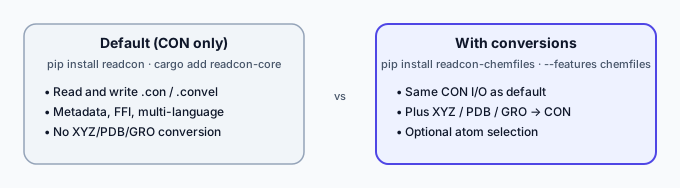
Linking libchemfiles pulls CMake, a C++ library, slower builds, and weaker cross targets. Many consumers only need CON read/write.
Artifact |
Chemfiles linked? |
Typical use |
|---|---|---|
crates.io |
No (stubs) |
Embed CON I/O |
|
Yes |
Conversion + selection |
PyPI |
No (stubs) |
Lean |
PyPI |
Yes |
Conversion-oriented Python |
Public Rust modules chemfiles_import / chemfiles_selection always compile. Without the feature they return
ChemfilesImportError::FeatureDisabled so call sites do not need cfg.
Python always registers has_chemfiles_support / select_*; lean wheels
raise RuntimeError with a rebuild/install hint.
Two distributions avoid impossible dual wheels under one PyPI name (same
platform tag cannot carry two different binaries). Install one of
readcon or readcon-chemfiles per environment.
Why bonds live in frame JSON, not sections
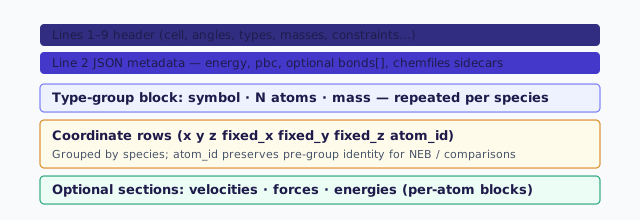
Header + JSON line-2 + type-group blocks + optional per-atom sections.
sections is the channel for per-atom optional blocks (velocities,
forces, energies, charges, spins, magmoms, displacements, spreads) with fixed column layouts and one
row per atom. Bonds are
frame-scoped edges (variable count, not N-aligned). Putting them in JSON
metadata matches energy / pbc / lattice_vectors: optional, preservable
by ignorant readers, validated when validate=true.
Angles and dihedrals are not required on disk in v0.13: chemfiles derives
them from bonds at selection projection time (add_bond graph). That keeps
CON files small while still supporting angles: / is_angle when bonds
exist.
Index spaces: chemfiles order vs atom_data vs atom_id
CON writers type-group atoms (all Cu, then all H, …). Column 5 atom_id
stores the pre-group index so NEB and comparisons can recover original
order.
On chemfiles import:
Chemfiles atoms are read in chemfiles order;
atom_idis set to that index.The builder type-groups into
atom_data.Bond endpoints are remapped into
atom_dataindices viaatom_idso on-diskbondsalways mean “indices into this frame’s atom list”.
Selection results are returned in ``atom_data`` index space. Parity tests against chemfiles C++ compare undirected multisets of matches after remap—not byte-identical index lists.
Display name (e.g. H1) vs atomic type (H) cannot both live in CON’s
single symbol column; import stores optional sidecars
chemfiles_atom_names / chemfiles_atom_types (chemfiles/=atom_id= order)
and restores them when projecting for selection.
How does selection work on a CON frame?
You pass a selection string; the library returns matches as CON atom_data
indices (type-grouped order on that frame). Typical strings:
Always useful:
name H,type O,all(need symbols, or import sidecars for display names distinct fromsymbol).Need topology:
bonds:/angles:/dihedrals:andis_bonded/is_angle/is_dihedralwhenmetadata["bonds"]is present. Angles and dihedrals are derived from the pair list at evaluation time; v0.13 does not store them as separate on-disk sections.Empty topology: without
bonds, topology selectors return no matches (not a hard error unless the string is invalid).
Under the hood, evaluation may go through a small optional ingress stack
(currently chemfiles when that feature is linked). Callers do not need to care:
the public APIs (select_on_frame, select_atom_indices, rkr_frame_select,
trajectory helpers such as select_atom_positions_on_frames) all speak CON
indices.
What selection cannot see on CON
Selection only sees what the frame stores (plus a few import sidecars). In particular:
No residues: there is no residue table, so
resnameand residue-centric filters have nothing to attach to. Import does not invent residues.Thin properties: optional
chemfiles_atom_properties(and similar) may carry a subset of foreign keys after conversion; most per-atom property maps from other formats are dropped.Pair bonds only:
bondsis an undirected edge list. No impropers, no ring tables, no residue connectivity beyond those pairs.No geometry minidialect: distance / angle / dihedral threshold strings that depend on carefully staged extra atoms (as in some third-party test suites) are not part of the CON regression surface. A string may still parse; that is not a promise of behaviour from another toolkit.
APIs and install matrices: Language bindings, Reference — Chemfiles conversion and selection (feature-gated conversion stack).
Place in the broader stack
Interchange hub: CON on disk; potentials (rgpot); rare-event clients (eOn and others); analysis (rgpycrumbs); multi-format ingress (chemfiles); campaigns (readcon-db); multi-language and ML consumers (hourglass ABI, DLPack, metatensor).